For good ideas and true innovation, you need human interaction, conflict, argument, debate.
Margaret Heffernan – Entrepreneur, CEO and writer
Few would disagree with the notion that innovation is driven by the sharing of good ideas. Where open innovation and closed innovation models differ is the question of who should be included in these conversations. Should they be heavily guarded within the walls of your organization? Or is a more collaborative approach more effective? In this article we will run through each approach and weigh up the merits of open innovation vs closed innovation to help you identify the right paths for your business.
What is Open Innovation?
In a nutshell, open innovation takes place within an ecosystem that extends far beyond the boundaries of a single organization. Instead of confining innovation processes inside the walls of a single company, open innovation has a more outward-facing philosophy willing to draw from a range of external stakeholders and sources. These can include customers, start-ups, experts and problem-solving communities, emerging technologies, academia and research, patents and more.
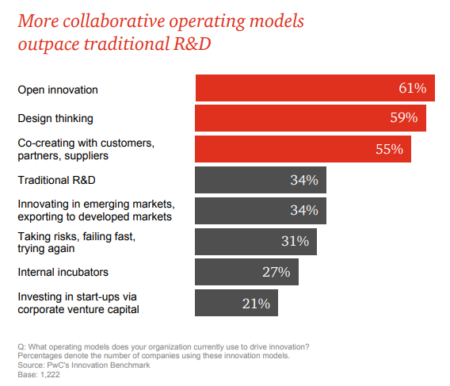
The thinking behind this is that by opening up the process of innovation to other stakeholders, an organization can innovate better or more efficiently by making use of the resources and know-how of the outside world. It’s a concept that is proving attractive to most companies: according to PwC’s Innovation Benchmark Report, 61% of businesses are using open innovation practices to generate new ideas.
Open Innovation: The benefits and challenges
We are currently being challenged by non-automotive technologies and competitors from entirely different industries. If we are to remain the technology leader, we need to open ourselves up to ideas from the outside.
Mercedes
A key advantage of open innovation is that the company can benefit from external resources when internal ones might be limited. Working with other businesses and individuals can make innovation more cost-effective and efficient, meaning that an idea could become cheaper and quicker to implement.
Another is that it allows you to work with players who have reacted faster to changes in the market. The world can move quickly, and other businesses may have already anticipated and adapted to important changes that your company hasn’t foreseen yet. Including these companies in the innovation process can speed up your organization’s ability to identify and respond to them, and so reduce the risk of being blindsided by new technologies, trends or other changes to the market.
As for the challenges presented by open innovation, it can be tough to manage the amount of information that can be amassed from innovating in this way, not to mention the various relationships with different partners and stakeholders. This is one of the reasons why it is so beneficial to have effective innovation management tools in place that can do the hard work for you.
What is Closed Innovation?
Essentially, closed innovation is the opposite of open innovation because it takes place exclusively within the walled garden of a single organization. From research to implementation and everything in-between, every aspect of innovation is conducted in-house. However, the extent to which innovation can be closed even within a single company can vary. For example, the traditional approach saw innovation siloed inside a business’s R&D department or boardroom. A more modern approach to closed innovation opens up the process across the whole company so that all employees can bring their ideas to the table.
The iPhone is a famous example of a product created as part of a closed innovation process. The concept itself and all of its technologies were designed and brought to life at Apple by its own employees.
The most attractive aspect of closed innovation for most companies is that the confidentiality around its innovation processes can help to disrupt the market with a new product or service that its competitors aren’t prepared for (just like the iPhone).
Closed Innovation: The benefits and challenges
Surprising the market with an innovation that has been kept under wraps increases the likelihood that the company will be the first and biggest beneficiary of its idea…unless you’ve been unlucky and another company has had the same idea at the same time!
Another benefit of the closed innovation model is that it focuses on drawing ideas from the company’s own employees, who know the business and its products inside out and have a wealth of experience ready to share.
Closed innovation does come with its own set of challenges. A smaller business might find that the closed model works well for some of its incremental innovations, but that it is harder to find the resources necessary for more demanding projects.
It fails to leverage the expertise and ideas of those outside the organization and because of this, it increases pressure on businesses to make sure that the best experts and biggest talents work directly for them. And it is high risk: the onus is on the company to anticipate and respond to changes in the market on its own.
Open Innovation vs Closed Innovation: Which is right for my business?
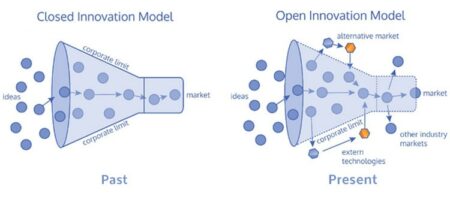
An important thing to remember when weighing up open vs closed innovation is that the two models don’t have to be mutually exclusive. A purely closed innovation model might work for a company like Apple, which was an early leader in the smartphone market and has the necessary resources and pulling power to attract the best talent from all the fields relevant to its innovation goals. As we’ve seen, however, most companies are finding that there are huge rewards to be gained by tapping into the vast resources and expertise of the world beyond its own four walls.
Your business may well find that both open innovation and closed innovation processes can be applied to different projects and different audiences. It may be able to make significant innovations based on the ideas of its own staff and with the resources it can leverage internally. For other innovations, the business might benefit from working with external experts, start-ups and providers of new technologies who can bring other ideas and resources into the conversation. Variables such as the size of the business, its resources and capabilities are all factors that can be assessed when determining whether to opt for an open model, a closed one, or a hybrid combination.
How Qmarkets can power innovation at your company
Whichever approach your business decides to use, one of the most effective ways to manage and streamline the process is with an innovation management platform. At Qmarkets we have dedicated solutions tailored to these separate use-cases.
Our Open Innovation Software offers an end-to-end innovation ecosystem that is scalable, intelligent and efficient. Using our Q-trend and Q-scout platforms, your business will be able to research and track the latest trends across your industry, and engage with the external partners and resources best-placed to drive your innovation success.
Take a look at our product page to find out more about how Qmarkets can help you to leverage unlimited innovation potential, or check out our Expert Spotlight Webinar.
And if it’s a closed innovation model that would work better for your business, our Q-ideate idea-sharing platform can harness the collective intelligence of your employees to drive your innovation efforts.
Working with Qmarkets, your business can even run open innovation and closed innovation processes simultaneously and within the same system, ensuring that separate audiences and stakeholders can see only the information that is relevant to them.
Open or closed, Qmarkets has the tools to take your innovation to the next level.